Miniature Scale
Or how I learned to stop worrying and love the caliper.
We’ve all been there, we found the perfect miniature to add to our collection, waited with anticipation for it to arrive, tear open the packaging and place it next to our other models and… it’s HUGE! It doesn’t match at all! Now it’s useless, and we wasted money on it.
How do we prevent this from happening?
It’s all a matter of understanding miniature scale. In this article I’ll cover what miniature scale is, how different scales compare to each other, how we approach miniature scale at Terrapin Games, and how to make sure your ordered minis match your existing collection.
At it’s most simple, scale for miniatures is a way to compare the size of a miniature to a real world object it is meant to represent. Different miniature hobbies have their own common scale terms; model trains use letters (HO, N, O, etc.) to indicate the size of models compared to the width of the train rails in that scale, scale model kits use a ratio (1/35 or 1:35, 1/60 or 1:60, etc.) to indicate how much smaller the miniature is than a life size object it’s based on, finally gaming miniatures typically use a scale that just gives a number of millimeters (6 mm, 28mm, 32mm, etc.).
For gaming miniatures this scale size is meant to represent the number of millimeters between the bottom of a miniature’s foot to the middle of its eye-line, specifically assuming the miniature represents a 6 foot tall person standing upright. The designer then models everything else relative to that size. Compared to model trains or scale models which rely on very accurate scaling, gaming miniatures scale is more of a feeling, than a hard scale comparison.
Gaming miniatures of the same scale should feel like they belong next to each other, and be easy to recognize and play games with. As a result, gaming miniatures are often unrealistically scaled; vehicles and terrain may be larger or smaller than a real life counter part, characters are often made to look the same height even though people have different heights, and so on. To make matters worse, many designers alter the proportions of miniatures to achieve a style for their work or to improve use of the minis for gaming purposes. Taken together, this means that matching miniatures by different designers to look and feel right next to each other can be difficult or impossible, unless the designer specifically tried to match the scale and proportions of another designer.
What is a gamer or collector to do?
Let’s start by discussing the different common gaming miniature scales and how they compare to each other. If we can determine what we are trying to match minis to, that would be the first step in making sure that what minis we buy will work and feel right next to each other.
What is Miniature Scale?
How do gaming miniatures scales compare to each other?
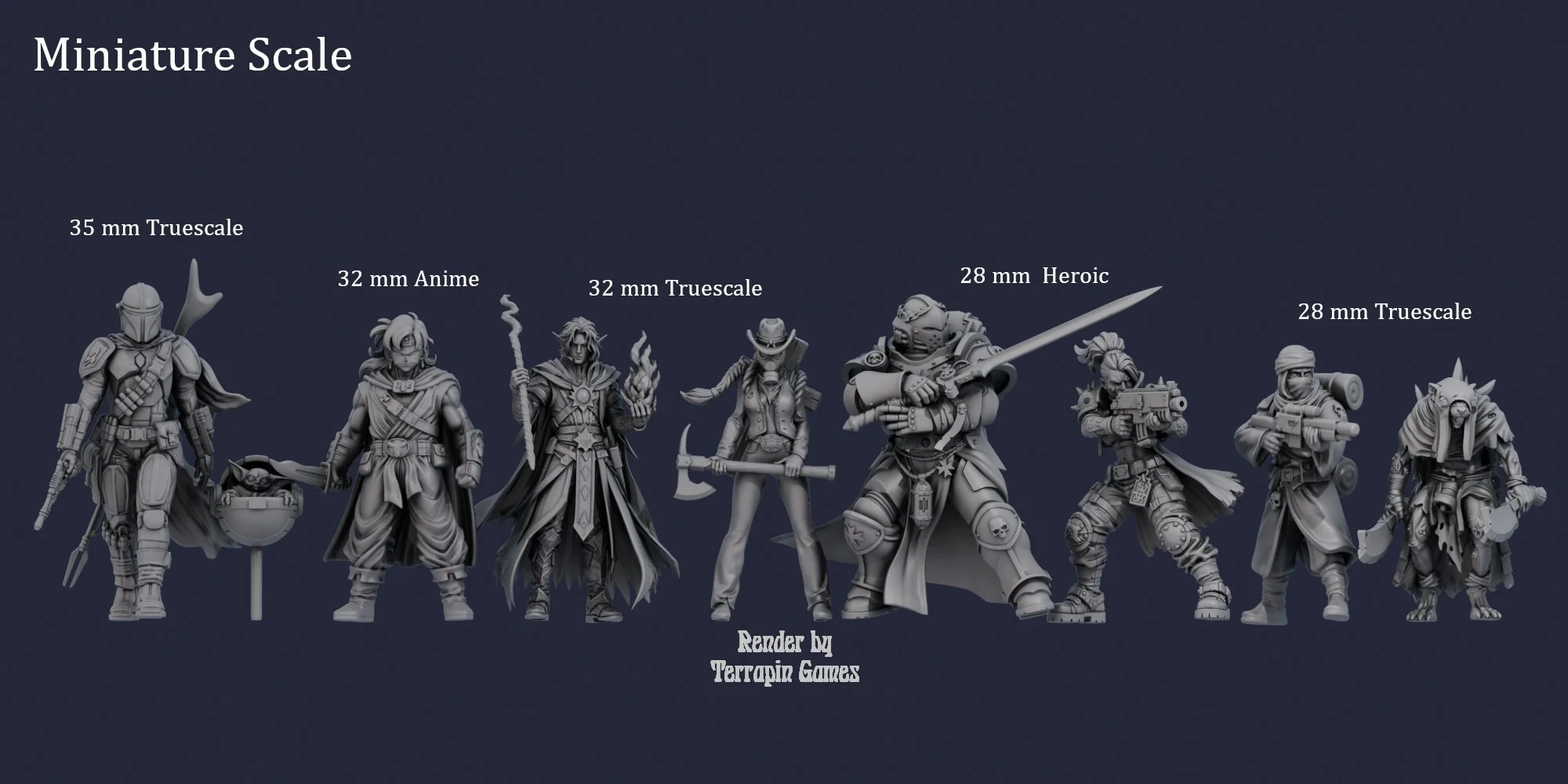
If you look, you can find gaming miniatures in almost every scale from tiny 6 mm all the way to massive 120 mm miniatures. For our ease, we will group different scale ranges into broad categories.
6 mm, 8 mm, 10 mm scales - Typically used for mass battle games like Legions Imperialis, Epic 40k, CAV Strike Operations, and Battle Tech.
15 mm - Typically used in historical battle games like Flames of War and other games based on historical wars (like Napoleonic wars, the US Civil War, or pike and shot period games). This scale has also become popular among gamers looking to scale down other popular games (like D&D or Star Wars Legions) to save cost on minis and terrain or allow for larger battles in a smaller table space.
25 mm - Decades ago this was a very popular scale for miniatures, today very few games are made in this scale.
28 mm - This is arguably the most popular scale for miniatures games currently. Many games use this scale including the mainline Warhammer games (40k, Age of Sigmar, Horus Heresy, and The Old World) and most RPG miniatures (like those made by Reaper Miniatures and WizKids) are also produced in this scale.
32 mm - This scale has become more popular over the last 20 years with games like Trench Crusade, Warmachine, and Malifaux in this scale, it has also become one of the most popular sizes for designers of 3d printed miniatures.
35 mm - This is an uncommon scale, but is prominently used in the Star Wars Legion products.
38 mm - This is an uncommon scale, but is used in the Conquest: The Last Argument of Kings system.
40 mm - This is an uncommon scale, but is used in the Marvel Crisis Protocol system.
50 mm, 75 mm, 120 mm - These scales are typically used for large display pieces rather than gaming.
Now if this isn’t confusing enough, I want to introduce the idea of Scale Creep. Many game systems started at a smaller scale and slowly over the course of the last few decades have crept into larger and larger scale miniatures. This is so common within the tabletop gaming industry that players started referring to it as “Scale Creep.”
The Games Workshop (Warhammer) properties are a perfect example, in the 70s and 80s GW’s miniatures were 25 mm scale, in the late 80s Citadel Miniatures (in the language of the ancients) moved officially to 28 mm for Warhammer games. Modern minis in the Warhammer 40,000 and Age of Sigmar product lines are creeping towards 32 mm scale, with newer models probably more accurately described as 29 to 30 mm scale. Though the official scale of Warhammer is still 28 mm.
This trend is widespread within the tabletop gaming industry. Many game lines have followed the same trajectory as Games Workshop and now several games that are officially listed as 28 mm scale tend to run a little bit over.
This leaves you a couple options to help determine the correct scale for your existing miniatures:
The first option is to use a set of calipers to measure the miniature’s scale directly. It is possible to use a ruler or tape measure instead, just be aware that getting an accurate measurement is harder and you will likely need to convert from inches to mm. You should choose a mini that is intended to represent a 6 foot tall person standing mostly upright (very dynamic poses are difficult to measure accurately) and measure the distance from the bottom of the model’s feet (or top of its base) to the model’s eye-line. The number in mm of this measurement is the scale of the miniature. Do not measure from the bottom of the base or to the top of the miniature, these will both cause errors in your measurement. Bottom of feet to eye-line.
If you do not have calipers (to be fair this is not a common tool everyone has), you’re best bet is some online research. Search for the scale of the miniatures you want to match and you’ll find plenty of information from others about what scale to use for any specific game or product line.
The best approach is to do both. Measure your miniature as best you can, and do some quick research online about what scale seems to match your specific miniatures best.
Finally, to throw some more fuel on the fire, let’s discuss proportions. The miniature’s scale alone only tells us how tall other miniatures should be to match it. There are a few common terms used to refer to a miniature’s proportions:
Truescale - These miniatures are proportioned to look realistic.
Heroic - These miniatures have exaggerated proportions and generally appear to be thicker and larger than a truescale miniature at the same scale size. Often characterized by particularly exaggerated hands, weapons, and heads. These type of models often appear like they are one or two mm larger in scale than a truescale miniature at the same scale.
Chibi - These miniatures generally have very exaggerated heads, significantly too large for their bodies.
Anime - This is not a common term for miniature proportions, but one I will be using to describe miniatures on this site. This style of miniature is typically designed to look like an anime character with various features exaggerated to make the model appear more cartoonish.
When trying to match existing miniatures, you should try to figure out the scale and proportions of the existing miniatures and find new minis that match. This can be a daunting challenge, but we’ve got you covered, there are several things we do to help make this easier for you.
How does Terrapin Games approach miniature scale?
Purchasing miniatures sight unseen from a website can be a nerve-wracking experience. At Terrapin Games, we have a number of practices to try and remove the doubt about what you’re looking to purchase and give you a better idea of what the finished miniature will look like next to the rest of your collection.
Accurate scale of miniatures:
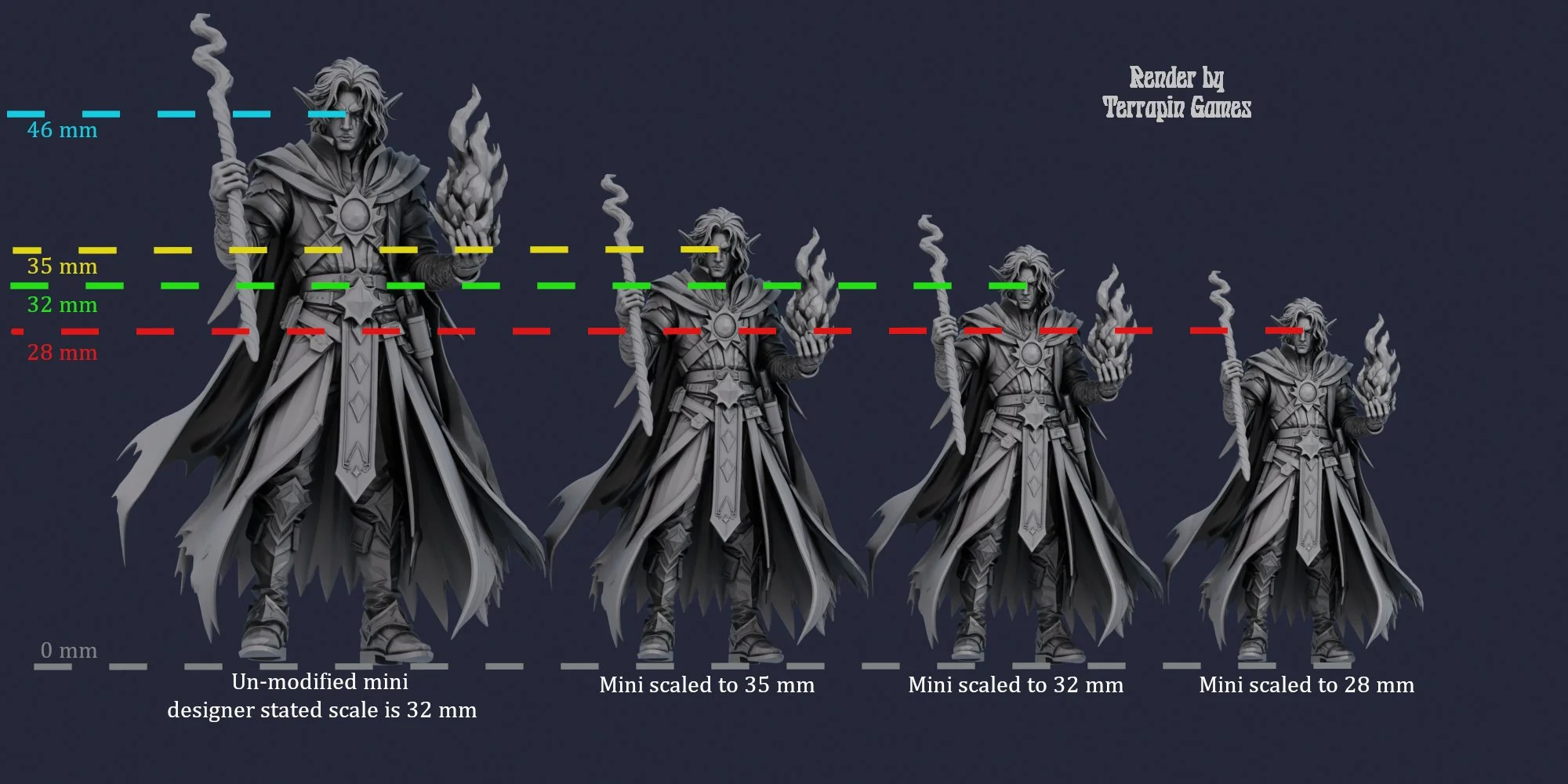
Often designers for 3d printed miniatures will report that their line is a particular scale but if the file is printed un-modified the actual scale could be very different. We specifically check and adjust the size of all of our miniatures to ensure that if we say a mini is 32 mm scale, the printed copy will be 32 mm scale. Not every 3d printing service does this. Many 3d printing services will print their minis at the designer’s un-modified size without verifying if that scale is accurate, or they will resize to a different scale assuming that the designer’s un-modified scale is correct. The final printed miniature may end up larger or smaller than desired.
Scale comparison images:
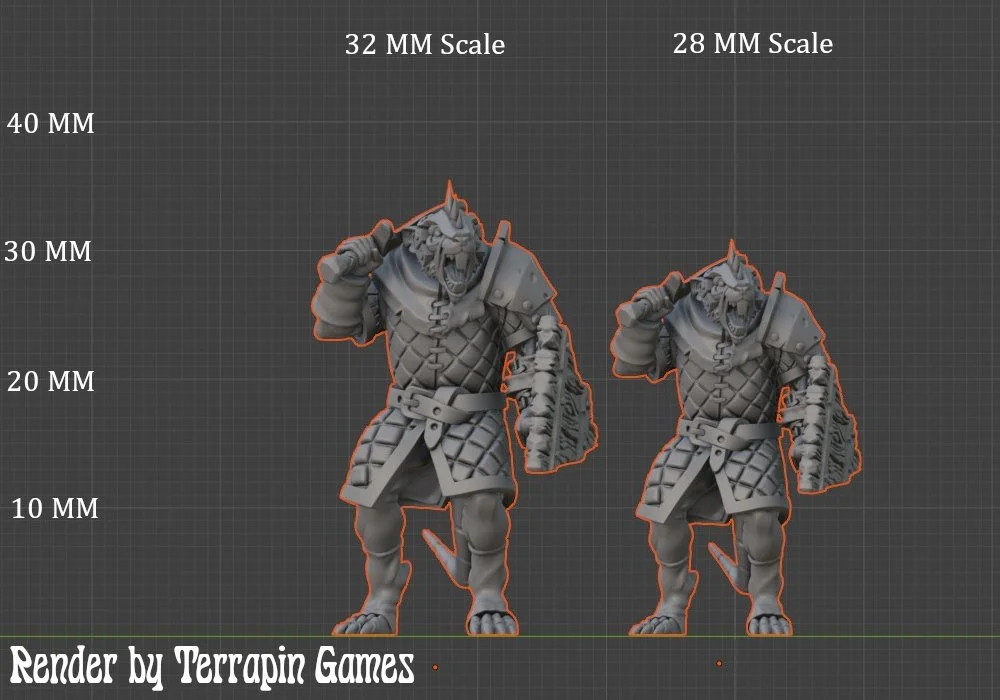
Every miniature listing on our site includes an image of the miniature with scale comparisons. For terrain we will generally provide rendered images of the terrain piece with an example miniature in the image to give you a sense of the size of the terrain. We generally use either a Star Wars Legion sized miniature or a Warhammer 40k sized miniature in the image. For figurines we provide an image of the miniature at the two most common scales against a grid backdrop with millimeter measurements along one side. This allows you to see exactly how tall the printed miniature will be, no guessing.
Buyer’s notes:
For every miniature listing we include a description of the scale and proportions of the miniature as well as brief notes regarding its comparison to other types of common miniatures. This will help you understand exactly what you’re looking at, and guide your decision toward the best miniatures to match your existing collection. If you have any questions about a listing, please feel free to contact us for more information here.
Customized miniatures:
We try to list our miniatures at available scales that are the most commonly desired. But the beauty of 3d printed miniatures lies in the ability to rescale miniatures as necessary. If you would like to buy a miniature at a different scale than we offer in the default options of the listing, please contact us directly (here) to request the miniature in a different scale. We can adjust the scale size of the miniature to your request.
Please note that we cannot change the miniature’s proportions, a 32 mm truescale miniature can be printed as a 28 mm truescale miniature, but we cannot make it a 28 mm heroic scale mini. Also note that some miniatures just are not feasible at drastic scale changes. Some miniatures have particularly thin or small pieces that will break if the miniature is scaled down too much and others lack the level of detail required to scale up significantly. We will discuss these concerns with you following your request for a customized miniature to make sure everyone is happy with the final product.
How to make sure your ordered miniature matches your existing miniatures?
Now it’s time to put all of the tools outlined above together. To make sure you’re getting the miniature you want follow these steps:
Verify the scale and proportions of the existing miniatures in your collection that you want the new order to match.
If the scale and proportions match, the miniatures should look good next to each other. You’re ready to order.
If the scale does not match, you can always request minis in a custom scale using our custom order request form.
If the proportions do not match, for example you want a miniature that is truescale to use next to Warhammer Age of Sigmar miniatures (heroic proportions) then you have a few options
For matching a new truescale miniature to an existing heroic miniature, I would recommend increasing the scale of the new miniature by about 7% (a 30 mm truescale miniature to a 28 mm heroic miniature). Up close the miniatures will not quite match, the resized truescale miniature will often be a little taller than the heroic miniature and still be noticeably thinner and less chunky, but the two will be pretty close and at a distance (like when they are all deployed on a table top together) the differences are hard to distinguish.
For matching a new heroic miniature to an existing truescale miniature, I would recomment decreasing the scale of the new miniature by about 7% (a 26 mm heroic miniature to a 28 mm truescale miniature). Up close the miniatures will not quite match, the resized heroic miniature will often be shorter and stockier than the truescale miniature, but the two will be pretty close and at a distance (like when they are all deployed on a table top together) the differences are hard to distinguish.
For matching a new anime or chibi miniature to an existing truescale miniature, I would recommend matching the scale size. The anime/chibi miniature will still have cartoonish proportions by comparison, that’s the point of the miniature, but the two will look pretty similar.
For matching a new anime or chibi miniature to an existing heroic scale miniature, I would recommend increasing the scale of the new miniature by about 7% (a 34 mm anime/chibi miniature to a 32 mm heroic miniature). Again, the anime/chibi miniature will be more cartoonish and often still taller and thinner than the heroic miniature, but the two will be close.
Review our scale comparison images. You can use calipers, or a ruler/tape measure, to visualize the height difference between your miniature and the one you would like to order. You could even rescale the image on your device and hold up the existing miniature to the image to get a comparison.
For terrain and basing supplies these scale comparisons are generally not as noticeable. Terrain sized for 28 mm scale will generally look fine next to models between 28 mm and 32 mm scale. Likewise, terrain at 35 mm scale will generally look fine next to models between 32 mm and 35 mm scale.
Thanks for coming to my TED Talk.
Last updated: 7/14/26